How to get in
- Application deadline
- Fall entry (program starts in August): not published by the schoolSpring entry (program starts in January): not published by the schoolSee it in the deadlines table
- Selection method
- Points (ranked)Rank order by total merit points; highest scores admitted; no minimum merit score Details and source
- TEAS minimum
- 70% Check your score
- Points calculator
- Add up your points on this school’s published rubric
- Prerequisites
- 12 courses listed by the school See the list
Check yourself against these published rules
A checklist against the school’s published rules only: this is not a prediction of a decision. Section minimums, GPA, grade and recency rules, and anything else the school lists still apply; read the full requirements above.
Admissions requirements
Here is what Yuba College publishes about applying to its ADN program, taken from the school’s own website, catalog or application documents. Each row links to the page we used and shows the date we checked it. Requirements change from cycle to cycle, so confirm with the school before you apply.
| Requirement | What the school publishes | Source |
|---|---|---|
| Entrance exam | TEAS (latest ATI version) | SourceChecked |
| Minimum overall score | 70% | SourceChecked |
| Section minimums | Not published by the school | SourceChecked |
| Minimum GPA, overall | Not published by the school | SourceChecked |
| Minimum GPA, prerequisites or science | 2.0 science; 2.0 combined non-science | SourceChecked |
| Selection method | Points (ranked)Rank order by total merit points; highest scores admitted; no minimum merit score | SourceChecked |
| Application opens | 1st business day of February 8:00 AM (2027-02-01) | SourceChecked |
| Application closes | 2nd Friday of February 3:00 PM (2027-02-12) | SourceChecked |
| Published applicant and admit counts | Not published by the school | SourceChecked |
How we label selection. SEAPHE sorts each school’s stated method into one of five groups: Lottery, Points (ranked), Points and lottery (hybrid), Holistic review or Eligibility-based. The school’s own wording appears under the label, with a link to the page we used. How California nursing schools choose students.
Published points rubric
Add up your points on this rubric
| Criterion (school’s wording) | Points |
|---|---|
| Degree: BA/BS+=10, AA/AS=5 | 10 |
| GPA a) anatomy/physiology/micro 2.0-2.49=5 to 4.00=15; b) remaining prereqs same scale | 30 |
| Healthcare work (1500 h in 5 yrs): licensed/certified 20, technicians 15, other direct care 10; volunteer/non-direct (200 h) 5 | 20 |
| Life experiences/special circumstances (awarded once) | 5 |
| Lives in HRSA medically underserved area | 5 |
| Language proficiency | 5 |
| TEAS: 70-73=10, 74-81=15, 82-89=20, 90-100=25 | 25 |
| Maximum total | 100 |
Rubric source, checked . Point values are the school’s; they change between cycles.
Prerequisite courses
Course names are the school’s; the grey label is the category SEAPHE uses in the prerequisite planner.
| Course | Requirements | Source |
|---|---|---|
| BIOL 4 Human AnatomyAnatomy |
| SourceChecked |
| BIOL 5 Human PhysiologyPhysiology |
| SourceChecked |
| BIOL 6 Intro MicrobiologyMicrobiology |
| SourceChecked |
| ENGL C1000 Academic Reading and WritingEnglish composition |
| SourceChecked |
| STAT C1000 Intro to Statistics or PSYCH 6Statistics |
| SourceChecked |
| CHEM 2A Introduction ChemistryChemistry |
| SourceChecked |
| HLTH 10 Principles of NutritionNutrition |
| SourceChecked |
| PSYC C1000 Intro to PsychologyPsychology |
| SourceChecked |
| Arts and Humanities course (GE Area 3)Arts and humanities |
| SourceChecked |
| Ethnic Studies GE (Area 6)Ethnic studies |
| SourceChecked |
| SOCIL 1 Intro to Sociology or ANTHR 2 Cultural AnthropologySociology or anthropology |
| SourceChecked |
| COMM C1000 Public Speaking or SPECH 6 Group CommunicationsCommunication (speech) |
| SourceChecked |
© Enzo Creationz LLC. All rights reserved. You may read and quote this with credit to “SEAPHE Nursing Data, seaphe.org”, but please don’t bulk-copy or redistribute it. Details
SEAPHE collected these details from official school pages. “Not published by the school” means we couldn’t find the detail on the school’s public pages when we checked; we don’t estimate missing values. “Could not be retrieved from the school’s website” means the page was blocked or wouldn’t load. Spot an error? See our corrections policy.
Admissions
The BRN does not publish acceptance rates for individual schools. Across California’s generic ADN programs, 35.0% of 22,970 qualified applications were accepted in 2024–25.4 This program is approved for 60 new students a year.2 Ask the school for last cycle’s qualified applicants and seats.
Applied here? Share your results in our 2-minute anonymous survey. It helps future applicants see what other applicants reported.
Cost
The BRN lists a cost of $6,470.03 before financial aid (Total Program).2 That figure comes from the school’s report to the Board and may not include housing, transport or exam fees. Check the program’s current cost of attendance.
Key facts
Last updated
- In 2024–25, 83.0% of 59 first-time NCLEX-RN testers from Yuba College (ADN) passed, compared with a California average of 90.2%. Source: CA BRN NCLEX-RN pass-rate tables, retrieved Oct 7, 2026.
- Across 2020–21 to 2024–25, its tester-weighted first-time pass rate was 92.6% over 310 testers (SEAPHE calculation). Source: CA BRN NCLEX-RN pass-rate tables, retrieved Oct 7, 2026.
- The BRN lists an approved enrollment of 60 new students per year for this program. Source: CA BRN list of approved RN programs, retrieved Oct 7, 2026.
- No national nursing program accreditation (ACEN, CCNE or CNEA) is reported for it to the BRN; BRN approval is what qualifies graduates for the NCLEX-RN. Source: CA BRN accreditation and attrition table, retrieved Oct 7, 2026.
NCLEX pass rates
In 2024–25, 83.0% of 59 first-time testers passed the NCLEX-RN, 7.2 points below the California average of 90.2%. Over five years, 92.6% of 310 testers passed.1
First-time NCLEX-RN pass rate, by reporting year
Embed this chart
Free to republish under CC BY 4.0: credit “SEAPHE Nursing Data, seaphe.org” with a link back. The iframe updates when our data does; the image is a fixed snapshot.
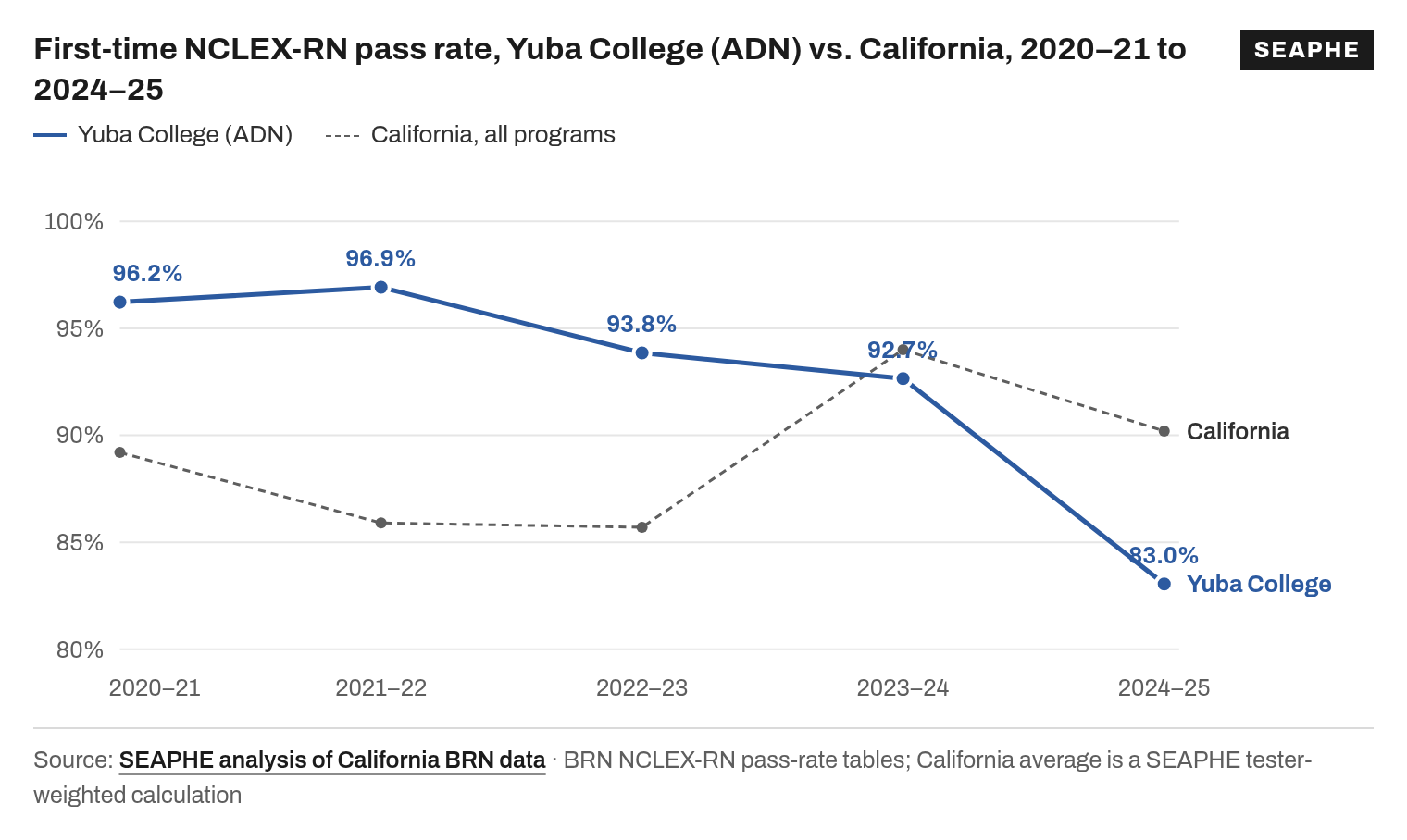
| Year (Jul–Jun) | Testers | Pass rate | California | vs. state |
|---|---|---|---|---|
| 2020–21 | 53 | 96.2% | 89.2% | +7.0 |
| 2021–22 | 65 | 96.9% | 85.9% | +11.0 |
| 2022–23 | 65 | 93.8% | 85.7% | +8.1 |
| 2023–24 | 68 | 92.7% | 94.0% | -1.3 |
| 2024–25 | 59 | 83.0% | 90.2% | -7.2 |
Completion and attrition
In 2023–24, the program reported 97% on-time completion and 3% attrition to the BRN.3
| Year (Aug–Jul) | On-time completion | Attrition |
|---|---|---|
| 2019–20 | 82.8% | 6.3% |
| 2020–21 | 100.0% | 0.0% |
| 2021–22 | 84.0% | 13.0% |
| 2022–23 | 93.0% | 3.0% |
| 2023–24 | 97.0% | 3.0% |
Self-reported by the program to UCSF for the BRN Annual School Survey.
Accreditation and program facts
| State approval | California BRN |
| Institution | ACCJC/WASC-JC |
| Nursing program | None reported |
| Degree | ADN |
| State | California |
| City | Marysville |
| Sector | Public |
| Admits | Generic pre-licensure |
| Phone | (530) 741-6784 |
| Website | Visit |
State approval and program details from CA BRN, Approved Pre-Licensure RN Programs. Institutional and nursing program accreditation from CA BRN, Accreditation, Attrition and On Time Completion Rates. Retrieved Oct 7, 2026.
Similar programs
| Program | Testers | 2024–25 | 5-year |
|---|---|---|---|
| Ventura CollegeVentura | 77 | 100.0% | 97.0% |
| Rio Hondo CollegeWhittier | 65 | 100.0% | 97.5% |
| Santa Monica CollegeSanta Monica | 65 | 100.0% | 94.2% |
| LA Harbor CollegeWilmington | 59 | 100.0% | 96.9% |
| Moorpark CollegeMoorpark | 52 | 100.0% | 99.1% |
| Mira Costa CollegeOceanside | 46 | 100.0% | 96.1% |
Sources
- California BRN, NCLEX-RN Pass Rates, First Time CA Educated Exam Testers, 2020–21 to 2024–25. Retrieved Oct 7, 2026.
- California BRN, Approved Pre-Licensure RN Programs (cost, enrollment, sector). Retrieved Oct 7, 2026.
- California BRN, Accreditation, Attrition and On Time Completion Rates. Retrieved Oct 7, 2026.
- California BRN, 2024–25 Annual School Report: Data Summary, Table 3, p. 3.
SEAPHE Editorial Team. Data updated Oct 7, 2026. Spot an error? See our corrections policy.
How to cite this data
Suggested citation: SEAPHE. (2026). Yuba College (ADN): NCLEX-RN pass rates and program data [Data set]. Compiled from California Board of Registered Nursing public records. https://seaphe.org/schools/yuba-college-adn/ (updated Oct 7, 2026).
Original source: California BRN, NCLEX-RN Pass Rates: First Time CA Educated Exam Testers; California BRN, Approved Pre-Licensure RN Programs.